
Can Entire Change How We Build Software?
with Lizzie SiegleLizzie Siegle from Entire joined to build a Java FX card game live with Claude Code, testing whether Entire's AI-native platform holds up in practice. The idea behind it, storing a coding session in your own git repo instead of a vendor's server, is genuinely good. The same completeness that makes it useful also makes it a fine-grained surveillance tool the moment someone else is reading it.

YouTube
Can Entire Change How We Build Software?
Load YouTube video
This video is embedded from YouTube and will only be loaded after your consent. When loading it, personal data may be transmitted to YouTube or Google and cookies may be set.
More details are available in the privacy policy.
Project Source
Working Repository
Explore prompts, instructions, and examples used in the live modernization workflow.
Open repositorySession Timeline
- 00:00Introduction
- 01:40Meet Lizzie: From Hackathons To Entire
- 04:04What Is Entire.io?
- 09:05Entire Swag Giveaway
- 10:19Kicking Off The Live Coding Session
- 12:05Enabling Entire On A New Repo
- 13:48Prompting Claude Code To Build A Java Fantasy Card Game
- 16:06BMAD Skills vs. Superpowers
- 26:12Tests Pass, Building The Java FX UI
- 32:54Committing And Pushing The First Version
- 34:17Feedback For Entire: Windows Onboarding
- 38:21Mirroring And The Distributed Git Network
- 39:20Entire Analytics: Token Usage And Throughput
- 49:53Exploring A Bigger Open Source Repo
- 55:48Trails And Gates: The Agentic PR Workflow
- 59:23Open Source, Pricing, And Vendor Lock-In
- 01:03:14Entire CLI: Session Resume And Skills
- 01:07:59Final Game Demo And Wrap-Up
- 01:15:13Closing: Entire.io, Discord, And Team Size
I went into this session not knowing what Entire actually did. I'd looked at the site beforehand and told Lizzie Siegle, Entire's developer advocate, exactly that, on stream. So we skipped the scripted walkthrough and built something real instead: a fantasy card game in Java FX, Claude Code writing the code, Entire recording everything that happened around it.

What Entire actually stores
Entire's pitch starts from a real problem, in Lizzie's words. Agents now generate more code than any human reviews line by line, and a pull request only shows the diff. Never why an agent tried three approaches before the fourth one worked.
A pull request only shows you the diff. It never shows you the why.
Entire's answer: attach the whole session, prompts, reasoning, every tool call, every dead end, to your commit as a checkpoint, a hidden git ref written into your own repository. Think of it as a flight recorder bolted to your code. Unlike an actual black box, though, this one lives in a plane you already own: your git repository, not a server Entire controls.
One prompt built a working card game in eleven minutes
The build itself had nothing to do with Entire, worth saying plainly. One sentence into Claude Code, create a fantasy card game in Java FX, no spec, no clarifying questions, no skills invoked, shown at 13:48. Eleven minutes later, a working Maven project existed, tests passing, and Claude Code moved on to the Java FX interface on its own, shown at 26:12.
That looseness only works if you skip the interrogation step some AI workflows insist on. Lizzie normally uses a skill pack called Superpowers for test-driven development and code review; I normally use BMad for project planning, as we discussed at 16:06. Neither of us wanted that here.
I had to tell my CLAUDE.md file, don't use Superpowers for everything. Only use it if I tell you to, because I'd ask it something basic and it would ask me a question back.
That's a preference, not a flaw in either tool: both exist to slow an agent down, and for a short demo, slowing down is exactly what you don't want.
The dashboard sees everything, and that's the uncomfortable part
Once the commit landed, Entire's analytics view reported the damage: about 112,000 tokens for that single prompt, shown at 39:20. Claude Code reports usage in tokens; GitHub Copilot bills in something it calls AI coins. If Entire is the layer both funnel through, that's the first shared currency I've found for comparing agent cost across tools.
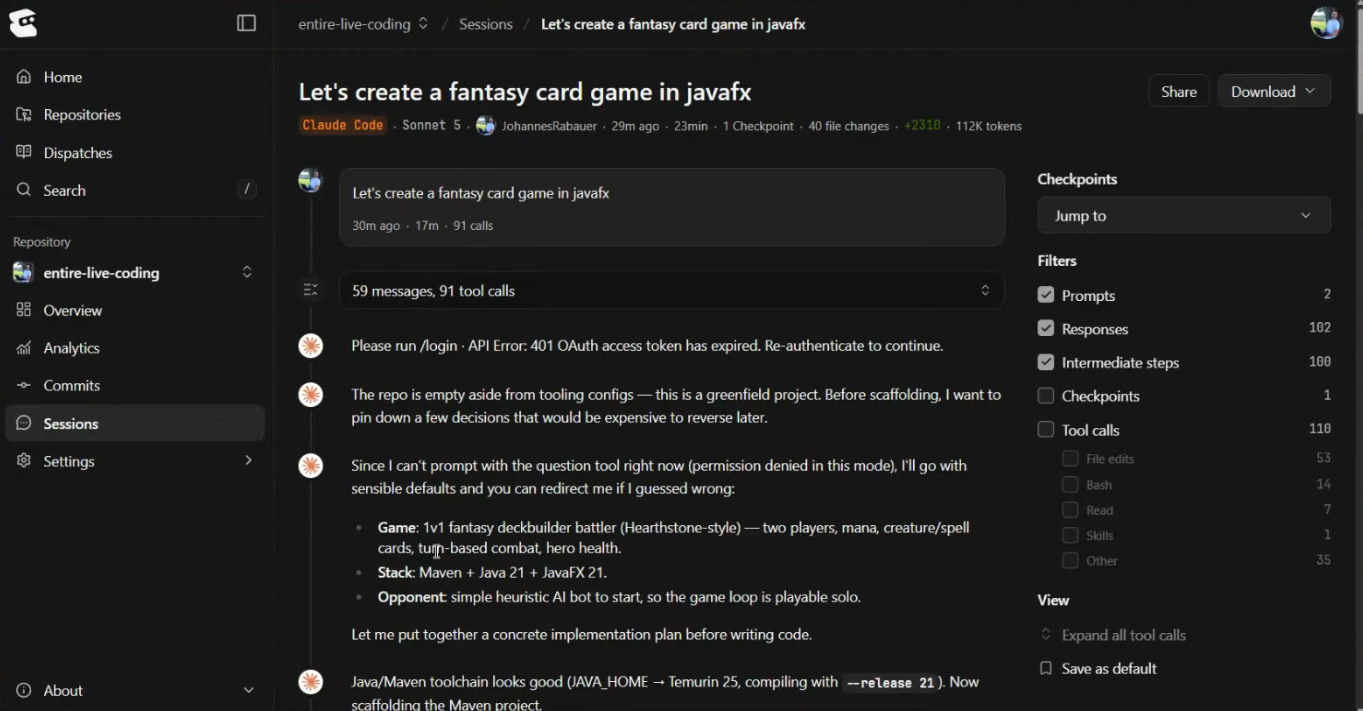
The dashboard also breaks token usage down per contributor, input against output. Lizzie's read: high input with low output usually means someone pasted in documentation; low input means terse prompting. A genuinely useful signal for how a teammate actually works with an agent.
It's also, without much extra effort, a surveillance tool. The dashboard doesn't just show that someone burned a lot of tokens, it can show what they actually typed, timestamped, attributed by name. Useful for understanding a colleague's reasoning after the fact. Uncomfortable the moment you picture a manager reading it that way instead.
A minor Windows inconvenience
Getting Entire's CLI installed on Windows happened before the stream, not during it: the install script assumes bash, so I needed Scoop first, per Entire's own install guide, feedback I gave Lizzie around 34:17. Nothing dramatic, just a small hurdle before the tool works. Live, enabling it on the repo was smooth: entire enable -y hooked in without a fight, shown at 12:05.
What we didn't get a clear answer on
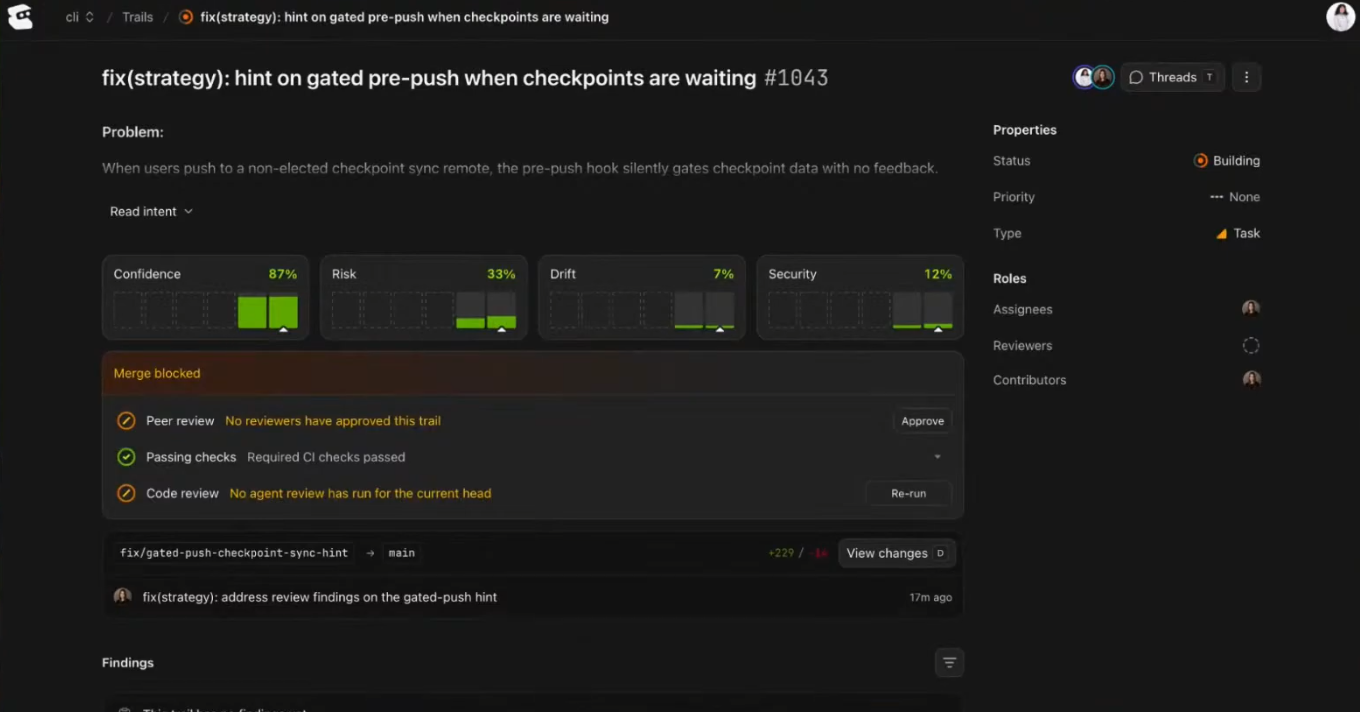
Lizzie showed two features that aren't public yet: Trails and Gates, shown at 55:48. A trail bundles an issue and a pull request into one object an agent or teammate can move through stages from the command line.
A gate is a merge check that can demand human sign-off, based on a confidence score Entire's own model calculates. A coherent idea, clearly not finished.
One question I kept circling back to: does storing hundreds of sessions per repo stay fast and useful once a project has real history, years of commits, not a fresh demo? Lizzie pulled up Entire's own CLI repo for contributor analytics, which was a good look at real usage, but it's still a young, comparatively small repo. We never got around to testing it on something genuinely old, and that's on my list, not a verdict against Entire. Worth revisiting once there's a repo old enough to actually stress it.
We also never tried Entire's three separately installable skills: Search digs up prior sessions by topic or file, Explain looks up the session behind a specific function or line, and Handoff lets another agent pick up a task's state instead of you reconstructing it by hand. Arguably the better version of what the dashboard does: stored history a developer can query, not one a manager watches.
Final thought
The one part of this I came away convinced by has nothing to do with the dashboard. Everything Entire stores lives in a git branch inside your own repository. Stop using it tomorrow, and your code and checkpoint history don't vanish into someone else's database. They're still sitting in the repo you already had.
Developers don't want to be locked in. We like choice, whether it's a different agent or a different harness. We're living in a multi-model world.
That's the real argument for trying Entire: the downside of being wrong about it is close to zero, since leaving costs you nothing you didn't already own. The tradeoff: the same recorder that preserves a teammate's reasoning for you also preserves it for whoever else has repo access. Worth knowing before you evaluate this for a team, not after.
Useful links
- Entire
- Entire's installation guide, including the Scoop command for Windows
- Scoop, the Windows command-line installer used to work around the bash-only install script
- Entire's Skills: Search, Explain, and Handoff
- Superpowers, the skill pack Lizzie compared to BMad
Comments
Load comments from GitHub optionally
The comment section is provided via Giscus and GitHub Discussions. It will only be loaded after your explicit consent. When loading it, personal data such as your IP address and technical metadata may be transmitted to GitHub, and cookies or similar technologies may be set.
Please confirm first before loading the comment section.