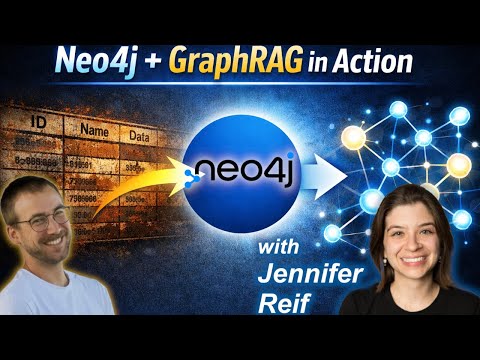
Neo4j + GraphRAG in Action: Live Refactor
with Jennifer ReifA two-hour live refactor that moved a file search app from PostgreSQL to Neo4j using GraphRAG and LangChain4j. The session didn't land, but four lessons made it worth the attempt.
YouTube
Neo4j + GraphRAG in Action: Live Refactor
Load YouTube video
This video is embedded from YouTube and will only be loaded after your consent. When loading it, personal data may be transmitted to YouTube or Google and cookies may be set.
More details are available in the privacy policy.
Project Source
Working Repository
Explore prompts, instructions, and examples used in the live modernization workflow.
Open repositorySession Timeline
- 00:00Introduction
- 01:11ai4jvm.com
- 02:02Explaining the plan
- 06:05Existing project with Neo4j changes
- 10:10Fixing dependencies
- 15:13Modeling entities
- 34:30Fixing application.properties
- 38:45Storing/Loading entities
- 42:58Ingest the data
- 01:02:30Testing the app (Spoiler: it fails)
- 01:10:50Fixing the dependency
- 01:13:00Integrating the KnowledgeGraphWriter
- 01:25:00Remodeling entities
- 01:34:30Storing/Loading entities again
- 01:42:55Embedding again
- 02:09:30Fixing startup problems (failing)
- 02:20:50Conclusion
Jennifer Reif from Neo4j joined me to live-refactor Quanta, a file search app, from PostgreSQL to Neo4j. The idea was to replace flat vector similarity search with GraphRAG: model files, embeddings, and their relationships as a native graph for richer AI retrieval. Stack: Quarkus, LangChain4j's KnowledgeGraphWriter, Neo4j.
It did not work. Two hours in, no functional result. But the failure was more instructive than a clean demo would have been.

What Is GraphRAG?
Standard RAG retrieves the most similar text chunks and passes them to the LLM. GraphRAG adds structure: it retrieves nodes and their relationships from a knowledge graph, so the LLM understands not just that two things are similar but why they are connected. For a file search app that means context shaped like your actual data, not a flat ranked list.
LangChain4j's KnowledgeGraphWriter writes entities and relationships into Neo4j during ingestion and hooks into the retrieval pipeline at query time.
How the Session Went
Dependency alignment between Neo4j OGM, the Quarkus Neo4j extension, and LangChain4j consumed the first stretch before any meaningful code was written. After modeling entities and wiring the KnowledgeGraphWriter, the ingestion ran. Testing at 1:02:30 then surfaced failures in how embeddings were stored and retrieved. The rest of the session was a loop of remodeling, re-embedding, and rerunning. At 2:09:30 we were still fighting startup failures. Honest conclusion: didn't get there.
Four Lessons
1. GraphRAG Is Not Plug-and-Play Yet
The concept is clear; the tooling is narrow. LangChain4j's Neo4j surface area is still limited and documentation leaves real gaps. What looks obvious in a diagram (write entities, link relationships, query the graph) becomes a chain of version conflicts and undocumented edge cases in practice. Go in with more preparation time than you expect.
2. OGM Was the Wrong Abstraction
Neo4j OGM maps Java objects to graph nodes. It is useful in many contexts, but it was the wrong fit here. LangChain4j's KnowledgeGraphWriter operates at the Cypher level with plain string values and does not compose with OGM. Skipping OGM and working closer to raw Cypher from the start would have removed a major source of friction. It would be genuinely useful if the KnowledgeGraph tooling eventually extended to support OGM-style abstractions and if the documentation became clearer about which integration styles are actually supported.
3. Align on the Concept Before Writing Code
Two minutes of introduction, then straight into code. That was too fast. The KnowledgeGraphWriter graph model was never fully shared between us before the session began. Different mental models of the same problem turn every technical decision into friction. A five-minute diagram first would have aligned us and likely surfaced the OGM issue much earlier.
4. Projects Need Documentation, Not On-the-Fly Onboarding
Quanta is small, but small does not mean self-explanatory. Explaining the project structure while simultaneously refactoring it means neither gets proper attention. Jennifer brought strong Neo4j expertise. What was missing was a clear, upfront picture of what Quanta does, how it is layered, and what I wanted to change. A short written overview would have paid back immediately.
Useful Links
- Neo4j + LangChain4j GraphRAG blog post
- LangChain4j Neo4j embedding store docs (KnowledgeGraphWriter)
- Neo4j OGM manual
- Session code: Quanta, branch
Add-Tags-and-Relations-with-neo4j - Jennifers Podcast: Break Time Tech Talks
Final Thought
GraphRAG is a good idea and Neo4j is a natural fit for it. The tooling just isn't frictionless yet, and that gap only shows up when you try it on a real project. This session was an honest look at where that gap currently is.
Comments
Load comments from GitHub optionally
The comment section is provided via Giscus and GitHub Discussions. It will only be loaded after your explicit consent. When loading it, personal data such as your IP address and technical metadata may be transmitted to GitHub, and cookies or similar technologies may be set.
Please confirm first before loading the comment section.