
Spec-Driven Development and the AI Unified Process
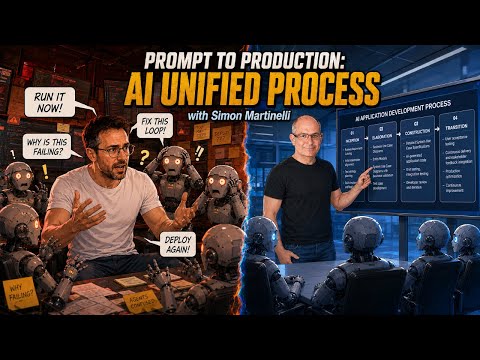
with Simon MartinelliSimon Martinelli introduced Spec-Driven Development and the AI Unified Process, then walked through all four phases live — from Vision document to a running Vaadin app scaffolded from a Maven archetype, with Claude Code handling most of the implementation.
YouTube
Spec-Driven Development and the AI Unified Process
Load YouTube video
This video is embedded from YouTube and will only be loaded after your consent. When loading it, personal data may be transmitted to YouTube or Google and cookies may be set.
More details are available in the privacy policy.
Project Source
Working Repository
Explore prompts, instructions, and examples used in the live modernization workflow.
Open repositorySession Timeline
- 00:00Introduction
- 06:50Spec-Driven Development
- 25:45AI Unified Process
- 48:03Creating the Vision
- 53:50Creating the Requirements
- 01:00:18Creating the Entity Model
- 01:05:32Creating the Use Cases
- 01:08:54Creating one Use Case Specification
- 01:14:30Creating the Java Project (from a Maven Archetype)
- 01:24:55Creating Flyway migration
- 01:30:10Implementing one Use Case
- 01:35:18neon.tech / Fly.io
- 01:40:50Looking at the implementation
- 01:48:00Some debugging
- 02:00:30Looking at the running App
- 02:07:30Failing Deployment
- 02:19:45Conclusion
Simon Martinelli joined me for a session built around two complementary ideas: Spec-Driven Development as a philosophy, and the AI Unified Process as a structured workflow to put it into practice. We worked through all four phases live, starting from a blank Vision document and finishing with a running Vaadin app — and a deployment that came very close.

Co-Speaker
Simon Martinelli
Java Architect and author of the Vaadin-JOOQ Archetype
Simon joined the session to introduce Spec-Driven Development and walk through the AI Unified Process end-to-end, from Vision document to a running Vaadin app.
What Spec-Driven Development Means
Simon's core idea is straightforward: a specification contains nothing technical. It is a pure business requirements document — what the system should do, for whom, and under what constraints. No framework choices, no data models, no API signatures.
Once that spec exists, you hand it to the AI and let it implement the application. When requirements change, you update the spec first, then let the AI propagate those changes into the code. The spec is the single source of truth that drives everything.
That is a clean separation. It keeps business concerns and technical choices in different places, and it gives the AI a more focused job.
The AI Unified Process
The AI Unified Process (AIUP) is a structured approach to AI-assisted development, inspired by the classic Unified Process. It organizes work into four phases:
Inception: You create a Vision document, a Requirements catalog, and a Test Strategy. This phase is about alignment — what are we building and why?
Elaboration: You build out the architecture artifacts: an Entity Model (the domain objects), a System Use Cases file listing actors and their actions, a Software Architecture Document covering tech stack choices, programming language, and library decisions, and Acceptance Tests.
Construction: You implement and test code from the specs. Every piece of output — code and documents alike — goes through review.
Transition: You deploy the application and run User Acceptance Tests.
Each phase has dedicated AI skills available at the AIUP marketplace. That marketplace is what makes the process practical: instead of prompting from scratch for each artifact, you invoke a purpose-built skill that already knows what to produce and how.
Walking Through Each Phase
We went through every phase live, using marketplace skills at each step.
In Inception, we created the Vision document and the Requirements catalog. That gave us a clear picture of what the application was before we touched any code.
In Elaboration, we produced the Entity Model, then the Use Cases file, then individual Use Case Specifications, and finally the Software Architecture Document.
Once Elaboration was done, we moved to Construction and used Simon's Vaadin-JOOQ Archetype to scaffold the Java project. The archetype does a lot: it sets up the project structure, the build, and the stack defaults in one step. After scaffolding we generated Flyway migrations from the Entity Model and started implementing one Use Case end-to-end.
Claude Code and the Archetype
The Vaadin-JOOQ Archetype got us moving fast. Combined with Simon's additional AIUP skills, the scaffolding and first implementation steps felt smooth.
One thing we saw along the way: we did not need the Vaadin Claude Plugin at all. The archetype plus the marketplace skills gave Claude Code enough context to handle Vaadin-specific output correctly.
What did slow us down was Claude Code itself. It was noticeably sluggish that day. The most likely cause was either a Pro subscription rate limit or Docker sbx blocking outbound network requests — something we only suspected toward the end of the session. That forced us to spend more time in the Construction phase than we had planned.
Almost to Production
Toward the end we set up neon.tech and prepared for deployment to Fly.io. Both services need minimal configuration, and neon.tech's ability to scale a PostgreSQL database to zero when idle makes it a good fit for demo setups.
We did not finish the deployment. A minor issue with the Fly.io configuration meant the app did not go live inside the session. That was a time and tooling problem, not a structural gap in the process.
Takeaways
Spec-Driven Development feels like a natural extension of the ideas behind Guided Coding, Vise Coding, and Semantic Contracts: give the AI a clear, scoped target and it performs better. Keeping the spec in purely business terms, with no technical detail leaking in, is a sensible constraint that is easy to underestimate.
The AI Unified Process is a genuine step toward a standard approach for AI-assisted software development. The four-phase structure, the artifact definitions, and the marketplace skills lower the activation energy for getting started. The honest downside is that AIUP is not simple on first contact — there are many moving parts, and it takes a few practice runs before the process starts to feel natural. But that is true of most structured workflows. Once you internalize it, you can adapt and deviate where it makes sense. AIUP is a process suggestion, not a rigid specification.
Useful Links
Comments
Load comments from GitHub optionally
The comment section is provided via Giscus and GitHub Discussions. It will only be loaded after your explicit consent. When loading it, personal data such as your IP address and technical metadata may be transmitted to GitHub, and cookies or similar technologies may be set.
Please confirm first before loading the comment section.